
Kahoka Criminal History Checks
A useful Kahoka search begins with the kind of event, not just a person’s name. A city incident can leave an agency report before any prosecutor files a charge. A custodial arrest can also produce a booking record at the county level. Once a charge is filed, the court docket becomes the best public path to the allegation and final result. Those records are connected, but they are not copies of one master file.
Use this five-step route to keep a Kahoka criminal record search tied to the office that owns each part:
- Identify the arresting or reporting agency from a citation, report number, court notice, or other original paper. Do not assume a standalone Kahoka police department handled the event.
- Ask Kahoka city government or the identified agency for the open parts of the incident report under the Missouri Sunshine Law.
- Call the Clark County Sheriff at 660-727-2911 for current custody, booking, bond, release, or warrant verification.
- Search Missouri Case.net with Clark County selected, then call the Circuit Clerk at 660-727-3292 for the official Kahoka case file.
- Use MACHS only when an open statewide Missouri repository response is needed, since it is not a substitute for a local report or certified case.
Kahoka’s Two Records Buildings
Kahoka is Clark County’s seat and largest incorporated city. The courthouse at 111 E. Court Street holds the Circuit Clerk and the official files for cases heard in the First Judicial Circuit. The Clark County Sheriff works from 518 N. Lincoln Street, Suite 1. That second office is the practical contact for arrest reports, booking status, local jail questions, warrants, and local sex-offender registration. A request at one counter will not automatically retrieve records held at the other.
This split gives Kahoka record seekers a simple test. Ask North Lincoln about what law enforcement did and whether someone entered custody. Ask the Circuit Clerk about what a prosecutor filed and what the court decided. The broader Clark County criminal history overview explains how those local records can later appear in state systems. Call before visiting because the official county pages do not publish sheriff lobby hours, clerk counter hours, local copy fees, parking rules, or a device policy.
Records at the Kahoka Police Department
No official Kahoka police records page, request form, app, or current department profile was located in the project research. That gap must not be filled with an assumption. Start by confirming which agency created the report. The Clark County Sheriff or Missouri State Highway Patrol may hold a record tied to an event with a Kahoka address. City government can help identify the city custodian or correct local channel when the paperwork does not name the agency.
A precise Kahoka request should state the event date and approximate time, location, involved party, incident or case number if known, and the exact item sought. Name the incident report, arrest report, booking sheet, CAD log, 911 audio, or relevant video rather than asking staff to compile a new summary. Specify whether inspection or copies are wanted and whether certification is necessary. Ask for an estimate first. No local city fee schedule or online request portal was found, and sensitive identifiers should not be sent by ordinary email unless staff gives a secure method.
Kahoka Charging Records Change Labels
An officer’s report may state one suspected offense, the booking screen may use another label, and the prosecutor may file a different charge after reviewing the evidence. The Clark County Prosecuting Attorney works at the courthouse in Kahoka and selects charges for state cases. A charging record is an allegation. The court’s charge-by-charge disposition is the source for whether a count was dismissed, resolved by plea, tried, or otherwise ended.
The official Clark County Prosecuting Attorney page shows the local charging office connected to Kahoka cases.
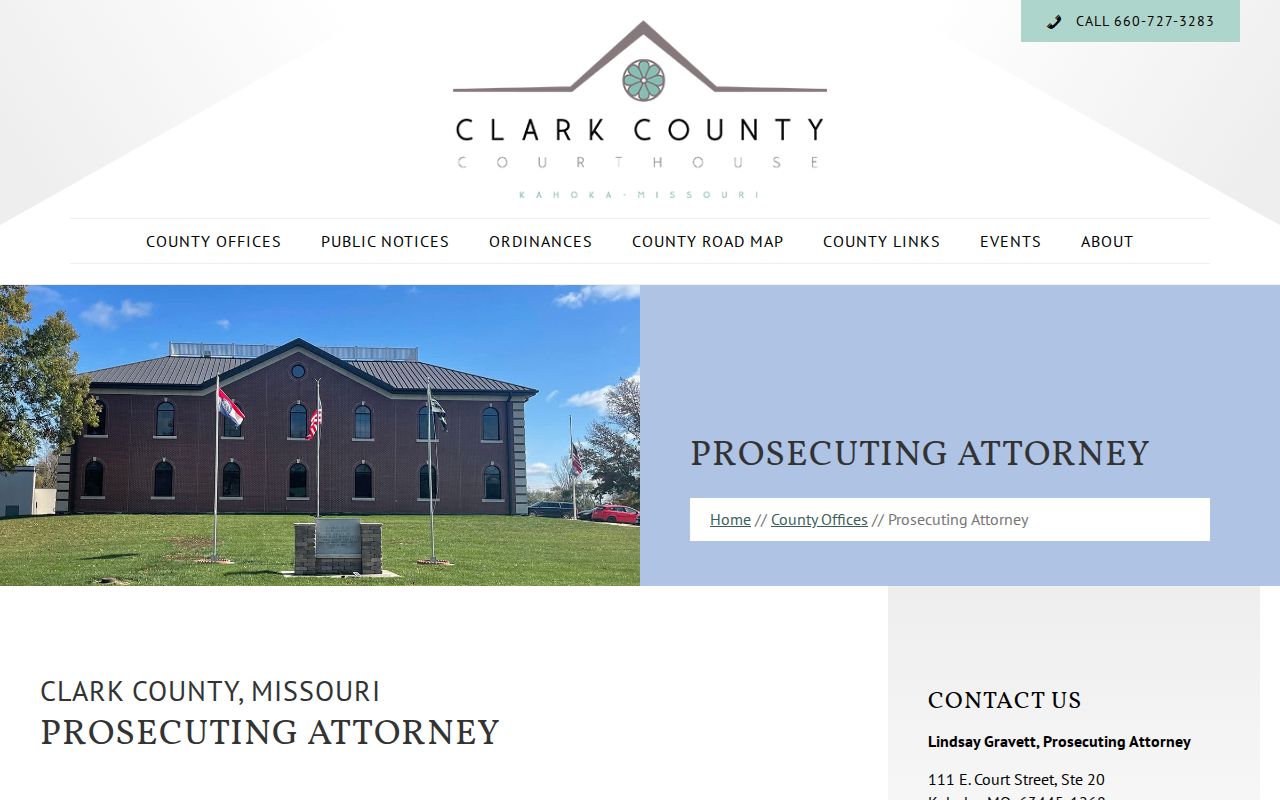
That office is part of the flow from a Kahoka agency report to a filed court case, but it is not the public counter for certified dockets or judgments.
When labels conflict, compare the incident date, arresting agency, case number, count, statute, and disposition. A common name alone is not proof that two records concern the same person. “Disposed” also means that the case has an outcome, not that every count ended in conviction.
Booking and Arrest Records in Kahoka
Kahoka does not publish an official web arrest blotter, city jail page, or booking search identified in the research. Call the Clark County Sheriff for recent custody and ask whether the person is held locally or was transferred. The research does not establish a separate Kahoka holding facility, so no page should claim one exists. A phone answer can help with current status, but a formal booking copy should be requested from the agency or custodian that keeps it.
A Kahoka booking record may contain a booking number, intake time, arresting agency, initial charges, warrant or case numbers, bond, court date, release details, and public identification fields. Release of each field depends on law and the record. The sheriff has not published a local roster or release policy. If a charge has been filed, Case.net and the Circuit Clerk supply the court slice, while the dedicated Clark County arrest search covers the full county channel sweep.
Note: A recent Kahoka arrest may not appear on Case.net until a prosecutor files a case.
New Kahoka Arrest Record Gaps
A blank court search soon after an arrest does not prove that nothing happened. Police and jail records can exist before a court case. The prosecutor must first decide whether and what to file. Data then moves into the judicial system, and public access may lag behind the real-world event. The right response is to identify the agency, confirm custody with the sheriff, and search the court again after filing could reasonably occur.
Do not use Missouri DOC Offender Search as the first test for a recent Kahoka arrest. DOC covers sentenced state custody and community supervision, not a person held only in county pretrial detention. Likewise, a MACHS no-record response may reflect a closed, nonreportable, missing, or not-yet-submitted event. The local report and court disposition remain vital. For a warrant, call the sheriff and the issuing court because Case.net is not a real-time officer-safety system.
The Kahoka Municipal Court File
The research did not locate a separate Kahoka municipal portal or confirm the current city-case routing. Search Case.net with Clark County selected. If the case is absent or its court label is unclear, call the Clark County Circuit Clerk and Kahoka city government to identify the municipal division and any city-held administrative copy. The clerk’s file, rather than a search screenshot, is the source for an official or certified disposition.
| Court Name | Confirm the Kahoka municipal division or routing with the Clark County Circuit Clerk and city government. |
|---|---|
| Case Types Heard | City ordinance matters where filed; do not infer broader jurisdiction from a city citation. |
| Case Lookup Channel | Missouri Case.net with Clark County selected, followed by the Circuit Clerk at 660-727-3292. |
| What the Docket Shows | Public case number, parties, charges, dated entries, hearings, judgments, sentence, and financial entries when available. |
| Copies & Fees | Ask the Circuit Clerk about current copy, certification, archived-file, and payment rules; no local schedule was located. |
Case.net can help discover a Kahoka file, but public documents may be redacted or unavailable online. Older files may require advance retrieval.
Kahoka Case Record Search Fields
Missouri Case.net offers several ways to narrow a Kahoka record search. Litigant Name Search works best with a full legal name and middle name when known. Case Number Search is stronger when a court notice provides the exact number. Filing Date and Scheduled Hearings searches can help when the name is common or a court date is known. Choose Clark County or the First Judicial Circuit where the form permits and select a criminal or municipal case type when exposed.
Open a likely result and compare the court, filing date, case number, party role, charge, and status. Review Charges/Judgments one count at a time. Docket Entries can show filings, hearings, continuances, warrants or capias events, pleas, judgment, and sentencing. Public document icons do not mean every filing is available remotely. Victim and witness details, full personal identifiers, juvenile matters, expunged files, and closed outcomes may be restricted.
How Kahoka Records Reach the County
A Kahoka incident starts with the agency that responds. If an arrest occurs, a detention record and fingerprint cycle may follow. The prosecutor reviews the report and decides what charge to file. The Circuit Clerk then maintains the official First Judicial Circuit case, while Case.net displays its public portion. Reportable arrest and disposition events can also reach the Missouri State Highway Patrol Central Repository.
Record flow: Kahoka reporting agency › Clark County Courts › Missouri State Highway Patrol Central Repository
This sequence explains why the freshest Kahoka record may be with an agency while the most complete outcome is at the clerk. State repository data is broader, but its public name product excludes closed Missouri and FBI records. If a disposition is missing, correction begins with the court or agency that owns the event, followed by the MSHP correction unit.
Kahoka Records and Federal Courts
A Kahoka address does not make every case a Clark County matter. Federal cases for this region belong to the U.S. District Court for the Eastern District of Missouri, and federal dockets use PACER. That channel should be used only when the event or paperwork points to a federal agency or federal case. A Missouri Case.net search does not cover federal court, and a federal file does not replace local Kahoka police, booking, or municipal records.
The official Eastern District of Missouri website provides the federal court layer relevant to Kahoka.
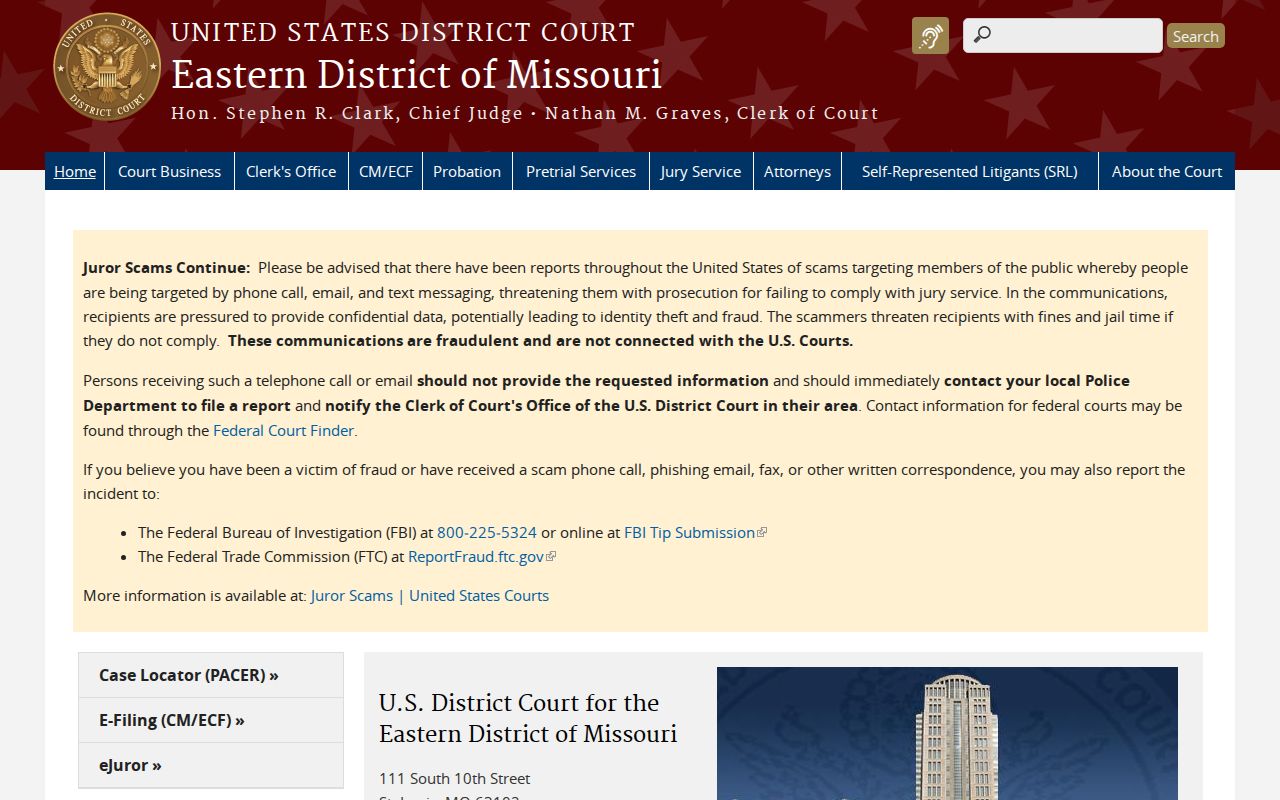
The image marks a separate jurisdictional path, not a second search for the same local city file.
Use the court name and case number on original papers to decide which system applies. For an ordinary city or county charge, remain with the local agency, Clark County Circuit Clerk, and Case.net.
Kahoka Record Types Are Different
A Kahoka report describes what an officer or agency documented. A booking file records intake, custody, initial charges, holds, bond, and release. A court case shows filed counts, hearings, pleas, rulings, and final dispositions. A state rap sheet organizes reportable arrest cycles and later outcomes around identity information. These products can disagree without any one of them being wholly false because they capture different stages.
Match records by more than a name. Compare the event date, agency, tracking or booking number, court case number, and charge disposition. Ask the Circuit Clerk for a certified result when the exact judicial outcome matters. For self-review of an incomplete Missouri repository history, first secure the court disposition or source-agency correction, then contact the MSHP Record Check Processing Unit with supporting records. Never read an allegation, arrest, or booking as proof of guilt.
Kahoka Record Access Rules
Kahoka agency records are governed by Missouri’s public-record framework, while court files also follow judiciary access rules. Request the existing record from its custodian. A public body may redact protected portions and release the balance. Active investigative material, juvenile information, victim identifiers, medical data, security details, and closed criminal history can be restricted. Ask for all reasonably segregable open parts and for the legal basis when access is denied.
Key Statutes:
RSMo §610.011 directs liberal construction of Sunshine Law openness and strict construction of exceptions.
RSMo §610.023 governs custodians, response timing, and authorized copy or research charges.
RSMo §610.100 addresses public and closed treatment of arrest records and reports.
RSMo §610.105 closes qualifying records after dismissal, acquittal, nolle prosequi, or completed SIS, subject to exceptions.
Court Operating Rule 2 controls access to Missouri judicial records and confidential case data.
The third-business-day rule is a response deadline, not a promise that every Kahoka request will be complete by then. Large or redaction-heavy requests can take longer if the custodian explains the cause and earliest availability.